Where we are. What we are building. What ships by October.
This report pulls together what the 2026 audience survey says about the readership, what the archive could become as a product, and where the commercial opportunities sit. It also lays groundwork for how Ripple might work across the newsroom: internally as a research and production tool, and externally in what the paper offers readers and members.
Prepared by Whitelabel AI for The Two River Times Foundation, drawing on the AI strategy workshop of 10 February 2026, the in-person kick-off of 24 June, the joint session with News Revenue Hub on 20 July, their technical review of 25 August, and the latest 2026 readership survey data.
Versionv1.1 · issued 8/26/26
Build window1 Jul → 23 Sep 2026
PositionWeek 9 of 12
FundingOpenAI grant
Working nameRipple
00
The brief, in one paragraph.
The grant is won and the build is running, so this is not a proposal but a discovery report. Backing from OpenAI’s People-First AI Fund, and the ambitions of the Two River Times team, create an opportunity to set a direction rather than follow one: to show how a nonprofit newsroom can use AI to deepen its connection to the community, and how new forms of membership can pay for it.
What this project delivers by early October
A working Ripple (the AI experience) across public, member and internal layers, a member application, a secure citation-grounded archive knowledge system, a metadata model covering people, places, dates, themes and relationships, and licensed access to the Whitelabel platform. Funded under the OpenAI People-First AI Fund grant.
What is still open
The name. Ripple is a working title. The decision underneath it is whether the archive layer gets an identity of its own (a mark that can stand apart from the masthead) or stays a product name under it.
How far to lean on the knowledge layer. Once the archive answers questions reliably, it can support more than search: newsroom research, analysis of gaps in the paper’s own coverage, and whatever share of the reader experience is built on top of it.
What sits at each tier. What the public gets for nothing, and how much of it. It has to be enough to be useful on its own, because that is what makes joining worth doing. What goes behind the paywall: full archive search, original issues, downloads. What a tier above $100 adds. And what stays with the printed paper alone. The sign-up flow all of this depends on is set out in joining, and what we learn when someone does.
Where we are today. Week six, the halfway point. The articles from 2007 onward have been processed into the AI, chunked and indexed. The layer answers questions against the indexed text: ask it about a person and it returns the page they appeared on. Next, we are embedding behavioural analytics into the website, so we learn how readers use it alongside what the survey reported, and adding an ingestion hook that indexes each new article as it publishes, so the archive stays current with the paper. Alongside that, we are defining the consumer-facing concepts set out later in this report.
01
Where we are.
We have taken the 230GB of archived PDFs covering 2007 to date and processed them into the AI knowledge layer, structuring the copy and the images inside them. A WordPress connection carries that forward, so each new article is processed the same way as it publishes. What the archive still lacked until now was any route in that did not begin with knowing the date.
The archive today.
~230GB
Archived PDFs, 2007 to date. Processed into the knowledge layer, chunked and indexed.
Done
~270GB
Photo assets on the same server, searchable by filename only. Metadata enrichment is what opens them.
In progress
2007
Weekly editions run unbroken from here to today, one folder per issue. Complete and consistently filed.
Full coverage
1990
Earliest physical copies. Between 1990 and 2007 the record lives on CDs, zip discs and paper. That period is excluded from Phase 1 by agreement.
Future phase
The constraint was access, not volume
Everything was organised by issue date. A reader who remembered a story but not the week it ran had no route in. Staff answered archive questions by hand, and when someone called asking whether the paper covered their family, the internal answer was we might have. The way Ripple indexes the archive changes this: articles are chunked and searchable, so the route in is a question about a person, a place or a story, not an issue date. Ripple is scoped to search, not storage.
Membership, mid-transition.
~4,000
Members, up from a standing start as subscriptions convert to memberships.
Conversion still in progress
$100
The membership ask, against legacy subscriptions of $30–45. Available as one payment or recurring.
Roughly a doubling
517
Audience survey responses, closed 29 July. Analysed in full in section 02.
Closed
The constraint is the joining flow, not the ask
The transition is still running: postal subscribers are converting to digital membership, and even the digital side needs work. The joining forms are outdated, there is no one-click, mobile-optimised way to pay, and nothing in the flow captures real member insight: who is joining, and what they personally care about. The member application in this build is scoped to close exactly that gap.
Current state.
Capability
Status
Detail
Print archive, 2007 to today
In the AI layer
Roughly 230GB of weekly PDF folders, complete and consistently filed by issue date. Now processed into the AI knowledge layer: chunked, indexed, and searchable by meaning rather than by date.
Photo archive
Partial
Around 270GB on the same server, searchable by filename only. Typing “surfing” returns nothing unless a person happened to put that word in the filename, so the library is effectively closed to anyone who did not file it.
WordPress connector
In progress
An integration with the paper’s WordPress, so Ripple knows the news in real time: each article is indexed as it publishes, and the articles already stored in WordPress join the archive corpus alongside the print record. Connector code is being shared with the Two River Times team now.
Membership programme
Live, needs optimisation
Just under 4,000 members, run with News Revenue Hub, mid-transition from subscriptions to memberships. It is up and running. What it needs is a state-of-the-art intake form to capture member interest data, one-click and easy payment options, and the steps in an order built for conversion.
News Revenue Hub technical review
In progress
A technical meeting is booked with News Revenue Hub to establish the full migration picture: what the hosted forms can be adjusted to do, what the member data actually looks like, and whether that points to upgrading the platform or retrofitting what is already there. This is the week-6 conversation the risks section calls for, and it gates W5 and W6.
Lifecycle email
Live but static
Welcome and renewal series running automatically in Mailchimp. Good infrastructure, but no personalisation and no AI optimisation. Everyone receives the same content.
Member interest data
Absent
No per-member profile of what a reader actually cares about, so nothing can be tailored. This is the precondition for everything in W5 and W6.
Sources: AI strategy workshop, 10 February 2026 (membership structure stated by the Two River Times team). Statement of Work, May 2026 (archive sized at approximately 230GB of PDFs and 270GB of photo assets, and the source for all scope, phasing and exclusions in this document). In-person kick-off, 24 June 2026. Joint session with News Revenue Hub, 20 July 2026 (survey progress and membership operations). Figures are as reported in those sessions and have not been independently audited.
02
What readers told us.
The 2026 audience survey closed on 29 July with 517 responses. It was not designed to test Ripple (the archive is never mentioned in it), so it cannot tell us whether the product will land. It describes the readership Ripple is being built for: where they live, how old they are, what they say they would lose, and how they use and view AI.
517
Responses to the 2026 audience survey, 8–29 July. Most questions were answered by 431.
Closed
44
Net Promoter Score. Above the benchmark for regional news.
n=431
70%
Say that if the paper closed they would lose news they cannot find anywhere else.
n=431
65%
Are 65 or older. Under-45s are 4.7% of the sample. This is the readership the member app has to serve.
n=431
How to read these numbers
This is a self-selected survey of an existing readership, promoted to people who already read the paper, and 82% of respondents have been following for more than a year. It describes the committed core very well and the wider community not at all: only two respondents in 517 had never heard of The Two River Times. Treat every figure here as a fact about members and near-members, never as a fact about Monmouth County.
Two further limits. Questions 3, 4, 5 and 7 were answered by an early wave of 38–50 people before the main fielding and are superseded by questions 13, 14 and 15; only the later versions are used here. And the two “where do you get your news” questions were single-choice, which respondents objected to repeatedly in the free text (“I can only click one but get my news from several sources”), so those shares understate every source below the leader.
Where the readership actually is.
461 respondents gave a usable postcode. They map almost exactly onto the two rivers the paper is named for: 64% live in the fourteen towns along the Navesink and the Shrewsbury, and Red Bank alone is one respondent in six. 27 of the 461 came from outside New Jersey.
12077Bubble area ∝ responses. Towns on true coordinates; water indicative.
Red Bank16.7%77
Little Silver8.9%41
Rumson8.2%38
Eatontown6.9%32
Middletown6.1%28
Atlantic Highlands4.3%20
Fair Haven4.1%19
Shrewsbury4.1%19
Highlands3.3%15
Holmdel3.0%14
Oceanport2.4%11
Monmouth Beach2.2%10
Asbury Park / Ocean2.2%10
Long Branch2.0%9
Leonardo2.0%9
Fifteen of 37 Monmouth towns shown. The top five towns are 47% of all located respondents.
Two-river footprint64.2%296
Rest of Monmouth25.6%118
Elsewhere in NJ4.3%20
Outside NJ5.9%27
The footprint is Red Bank, Little Silver, Rumson, Fair Haven, Shrewsbury, Oceanport, Monmouth Beach, Highlands, Atlantic Highlands, Middletown, Navesink, Leonardo, Belford and Port Monmouth. Two-thirds of the readership sits inside a ten-mile stretch of two rivers. Archive metadata has to work at town level.
Florida3replies
South Carolina4replies
Pennsylvania3replies
New York3replies
North Carolina2replies
Maryland2replies
Ten more states10replies
Colorado, Tennessee, Kentucky, California, Massachusetts, Maine, Texas, Wisconsin, New Hampshire and Puerto Rico, one each. These 27 people are the group most likely to want archive access and the membership model currently has nothing to sell them: “I live in Florida now but was raised in Red Bank in the 50s.”
What they would lose.
If the paper closed tomorrow · n=431
Lost news I can’t find anywhere else70%
Lost news, but findable elsewhere21%
Not impacted either way8%
Seven in ten treat the paper as irreplaceable rather than merely useful. The archive tier is being priced for that 70%.
Where else they follow Monmouth County · n=431
Social media20%
Red Bank Green16%
Asbury Park Press15%
News 12 New Jersey11%
Nowhere else at all10%
NJ.com8%
Single-choice, so these are floors rather than shares. Patch is not on the answer list and appears fourteen times in the free text. It is a competitor the survey could not see.
Where they stand on AI.
44% of respondents use AI at least weekly and a quarter are positive about it in general. Comfort rises sharply when the specific use is described.
Rarely23.9%~97
Daily23.2%~94
A few times a week20.7%~84
Never18.8%~76
A few times a month10.8%~44
Not sure what counts as AI2.2%~9
n=404. 44% use generative AI at least weekly, in a readership two-thirds of which is over 65. Most of this audience has used a chat interface before.
Neutral / mixed44.8%~181
Somewhat negative21.5%~87
Somewhat positive20.0%~81
Very negative8.4%~34
Very positive4.9%~20
n=403. Asked about AI in society, a quarter are positive and 30% are negative. The project cannot rely on general enthusiasm for AI.
Very comfortable31.9%~129
Somewhat comfortable28.4%~115
Neutral / unsure25.3%~102
Somewhat uncomfortable8.9%~36
Very uncomfortable2.7%~11
Didn’t know AI was used in news2.4%~10
n=403, asked immediately after a paragraph describing exactly what the newsroom uses AI for. 60% comfortable, 11.6% not (against 25% who are positive about AI generally).
The most actionable finding in the survey. The same sample that is 30% negative on AI in society is 60% comfortable with AI at The Two River Times. The difference is question 18, which stated what the newsroom uses AI for and what it does not. The disclosure paragraph is what produces the comfort. Ripple should carry it wherever the product appears, and W2’s “surface, never rewrite” line should be reader-facing rather than an internal principle.
What they read us for, and what would move them to give.
News43.2%186
Towns18.6%80
Lifestyle10.0%43
Other (write-in)9.5%41
People Pages6.7%29
Obituaries5.6%24
Business2.6%11
Food2.1%9
Sports1.9%8
n=431, single-choice. News and Towns are 62% between them, and 24 of the 41 write-ins are some version of “all of them”. Obituaries and People Pages look small here and are named constantly in the free text: a known artefact of forcing one answer.
I’m already a member32.4%133
Other (write-in)11.5%47
Just ask: I value your work9.8%40
Help me understand why you need it9.8%40
Knowing it keeps journalism free9.8%40
Proof the money is used well8.3%34
Flexible or lower-cost options8.1%33
Clear examples of impact6.8%28
Nothing: I’ll never give3.7%15
n=410. No single lever gets above 10%, and the 47 write-ins are dominated by one confusion: subscribers who do not know whether they are members. “I feel unclear, as a subscriber for many years are you looking for additional money?”
Shared an article with someone72.9%314
Visited a community business49.4%213
Attended an event39.0%168
Voted in a local election33.4%144
Contributed money to a cause29.0%125
Joined a community discussion10.7%46
None of the above10.0%43
n=431, select all: 1,080 actions from 431 people. Sharing is the dominant behaviour, which makes a shareable archive result a natural growth surface for the public layer in W4.
In their own words.
Every free-text answer readers left, 480 of them across six open questions, in one place. Search the words they used, or filter by what they were talking about. Nothing here is edited except to remove personal names.
480 shown
Conclusions: what the survey backs, and what it does not.
Read against the eight workstreams in the next section. The survey validates the audience thesis. It does not test the product. Nothing in 517 responses mentions the archive, because nothing in the questionnaire asked about it.
What we are building
Verdict
What the survey actually says
Aligns to
168 readers who asked to be contacted
Opportunity
A beta group already exists, and it selected itself. 168 readers gave an email address for follow-up, alongside 235 who entered the prize draw. They are engaged, warm to the paper and reachable today. Put Ripple in front of them as soon as there is something to touch: the archive search, the personalised digest, and the concepts set out in this report. The survey could not test any of it, because it never mentioned the archive. This group can, and what they do with it will be worth more than another round of questions.
Towns is the second coverage priority at 18.6%, 64% of readers live in fourteen adjacent towns, and the free text repeatedly names places: Oceanport council summaries, Rumson meetings, Highlands neglect, Freehold, Holmdel. Place is the highest-value tagging axis and should be sequenced ahead of theme.
Readers already multi-source: social media 20%, Red Bank Green 16%, Asbury Park Press 15%, plus Patch fourteen times in the write-ins. Only 10% read nothing else. A teaser public layer competes with free local rivals and loses; it has to be independently useful. The counterweight: 73% share articles, so a shareable archive answer is the cheapest reach the project has.
Comfort with AI at The Two River Times is 60% against 11.6% uncomfortable. General AI sentiment in the same people is 25% positive against 30% negative. The gap is produced by the disclosure paragraph. “Surface, never rewrite” should be reader-facing copy in the interface, not an internal principle. 44% already use generative AI weekly, so the interaction needs no tutorial.
The problem upstream of checkout is the offer, not the friction. 32% answered “I’m already a member” while write-ins show subscribers unsure whether a subscription is a membership, whether more money is being asked for, and why a newspaper is soliciting donations. One-click payment does not resolve that. What the flow needs is a clear value proposition, plain language separating a subscriber from a member, and the benefits at each tier stated up front, with easy payment and the right question order behind it. Set out in joining, and what we learn when someone does.
168 respondents gave an email address for follow-up and 235 for the prize draw. That is a standing research panel and a launch list, available now: enough to test archive prompts, pricing language and the member tier before anything ships. It is also the first real input to the per-member interest profile that W5 and W6 depend on.
27 respondents live outside New Jersey, from Florida to Puerto Rico, and describe themselves as former residents keeping up with home. They cannot use a delivered paper, so the current $100 membership offers them nothing. A searchable archive of their home town is worth more to them than to a local subscriber. Small numbers in this sample, and the sample only reached people already on the list. Worth sizing before Phase 2.
Not in scope
Source: The Two River Times 2026 Audience Survey, fielded 8–29 July 2026 via SurveyMonkey, 517 responses; export “Data_All_260729”. Bases vary by question and are stated against each figure. Postcode analysis covers the 461 of 471 postcode entries that parsed cleanly, mapped to 37 Monmouth County towns. Figures for questions 1, 10, 16, 17, 18, 19 and 21 were measured from the exported charts, which carry no data table, and are accurate to about half a percentage point; all other figures are read directly from the export’s response tables. Verbatim quotations are unedited apart from the removal of personal names.
03
The build. Eight workstreams, twelve weeks.
Eight workstreams, as signed. Phase 1 delivers a working Ripple across public, member and internal layers, plus the member application, on Whitelabel's existing closed-loop infrastructure. The governing principle: surface, never rewrite. Ripple points at journalism the paper already published and says where it ran. It does not generate reporting.
Eight cards side by side. Scroll the row, or jump to one with the codes above.
W1
Audit the archive and structure it before anything is ingested.
Approximately 230GB of archived PDFs and 270GB of photo assets on the internal server, audited and organised into a clean knowledge base first. Ingesting a messy library only produces a messy index.
Legacy formats are excluded by agreement. CDs, zip media and physical issues are recorded on the future roadmap rather than attempted now.
This is Discover and Define work, weeks one to five, the phase the engagement has just closed.
Signed scopeArchive audit and structuring.
We are here. Week six, the halfway point, with Define closed. A draft AI search bar is ready to share on the website. It is the first reader-facing part of this plan.
W2
A secure archive knowledge system that cites its sources.
Retrieval, not generation. The archive goes into a retrieval-augmented system that indexes and stores sources rather than rewriting them. Answers are drawn from approved Two River Times material first and carry a citation back to it.
It stays current on its own. A daily scraper pulls newly published content from the website into the index, so Ripple knows about this week's coverage as well as 2007's.
Guardrails against hallucination and usage logging are built in at this layer, not added afterwards.
Signed scopeSecure archive knowledge system · live ingestion.
The scope boundary. Ripple returns articles the paper published and cites the edition and page they ran on. It does not draft, rewrite or summarise reporting into anything that could be mistaken for a story.
W3
Metadata enrichment: search by meaning, not by filename.
AI-assisted tagging across people, towns and locations, dates and publication context, themes, and relationships between articles over time.
This is what turns a photo library that only answers to filenames into one that answers to subjects. It is the production team's most concrete request.
It also links related coverage across years, which gives the newsroom story ideas as well as better search.
Signed scopeMetadata enrichment.
W4
Three access layers, one archive.
Public. Curated prompts and discovery on the homepage, designed to earn a membership sign-up rather than to give the whole archive away.
Member. Full archive search, deep-dive exploration and access to original issues, behind login.
Internal. An enhanced newsroom mode with deeper retrieval and structured knowledge support, so staff stop answering archive questions by hand.
Signed scopeAccess layers.
The tiering is the commercial design. The public tier gives enough to show what the archive does; membership gives the archive itself. It is a concrete answer to “what do I get for the hundred dollars?”
A worked proposal for the public tier. Give an anonymous reader a small allowance of questions (four or five), then ask them to join to keep going. The allowance is large enough to show that the search works and small enough that anyone researching their town reaches the limit quickly. Sponsorship, if it happens, sits on that public tier and membership buys it away, which gives the paid tier a second benefit that costs nothing to produce. The constraint the tiering has to respect: none of this should give away what the printed paper sells. The archive is back catalogue, not this week's edition, and the line between them is a policy decision worth writing down before launch.
W5
Secure login tied to membership status.
Single sign-on that knows whether the person asking is a member, and a Salesforce integration that keeps access aligned to membership data.
Role-based access across the public, member and newsroom layers, so the three tiers in W4 are enforced rather than merely designed.
Integration requirements are confirmed during Define. This is deliberate, because they depend on systems outside our control.
Signed scopeSecure login and CRM integration.
The live dependency. The membership page is hosted by News Revenue Hub, which has sold the product to Indiegraph. Editing is limited and no API has been confirmed. This is the most likely cause of slippage in the back half of the build.
W6
The member application.
Archive search, RSS-fed digital newsletter, a paper-style reader experience, and a chat layer alongside the paper view, so a reader can ask questions about the page they are reading.
Format is an open decision. Native iOS and Android, or a single integrated web app. It is agreed during Discover and Define against member behaviour, accessibility for an older readership, and long-term maintenance.
The paper-style view matters more here than it would elsewhere. Readers have said repeatedly that they want the paper to look like the paper.
Signed scopeMember application.
W7
Make joining frictionless at the moment of intent.
Checkout and sign-up optimisation, including one-click Apple Pay and Google Pay, activated at launch through existing infrastructure.
The archive creates the moment of intent; this workstream stops a payment form losing it. A reader who has just found their family in 1994 should not meet a long form.
Directly supports the transition already in flight from $30–45 subscriptions to $100 memberships.
Signed scopePayment-aware optimisation.
W8
The platform layer: what the paper learns from all this.
Insight. Analytics on archive usage: top searches, knowledge gaps where results fall short, themes driving engagement, and how usage connects to membership behaviour.
Contacts. Each member's journey through Ripple builds an engagement profile tied to their membership status.
Outbound. The chats and searches members have with Ripple can be emailed to member and prospective-member inboxes, with campaign and newsletter content generated from real usage rather than guesswork.
Signed scopeWhitelabel platform · insight, contacts, outbound.
Knowledge gaps are a second output. Searches that return nothing useful identify subjects the paper has not covered, or has covered but not digitised. Both are inputs to what the newsroom reports next.
Joining, and what we learn when someone does.
The highest-leverage change outside the eight workstreams. Nothing in Ripple can be personalised to a member the paper holds no data on, and the moment of joining currently collects almost nothing. That is the point at which a reader is most willing to answer questions.
How it works today
A reader arrives at a hosted membership page, meets the price, and either pays or leaves. If they leave, nothing is kept: no email, no interest, no record that somebody got as far as the price and hesitated.
What the paper learns about the people who do join is a name, an address and an amount. Section 01 records the consequence plainly: member interest data is absent, and it is the precondition for everything in W5 and W6.
What we would propose instead
1. Email before the price. Capture it as the first step, not the last. Anyone who then hesitates at $100 has become a prospective member in a nurture sequence rather than a lost visit.
2. Payment second, with the fewest fields the processor will accept. Nothing is asked here that could cost the transaction.
3. Preferences after the money. Towns, topics, delivery day, and whether they want the digest. These are asked on the confirmation step, where a drop-off costs nothing and willingness to answer is at its highest.
The order is the change. The current sequence asks for payment first and never asks for preferences. Reversing it produces two assets the paper does not have today: a prospect list of people who wanted to join and did not, and an interest profile that exists from day one rather than being inferred from months of reading behaviour.
Three of the five concepts in this report are blocked without it. The personalised weekly digest, set out later in this report, cannot greet a brand-new member with “because you read Little Silver”: someone who joined this morning has no reading history yet, and watching behaviour takes weeks to produce anything. Only the sign-up form can supply that profile on day one. The member perk of nominating a local sports hero, also set out later, needs to know who is a member and how many nominations they have left, which again comes from sign-up. And the survey shows the naming problem is live already: 32% answered “I’m already a member” while the write-ins are full of subscribers unsure whether a subscription is a membership, or whether more money is being asked of them. That is a sign-up and language problem, and no amount of checkout optimisation fixes it.
The form is hosted by News Revenue Hub, and so far it has not been open to change. The joining flow runs on their platform, not the paper's, so the improvements above depend on a third party that has resisted changing it. The data still has to come from somewhere. The fallback is a short preference step immediately after sign-up, sent as the first email in the welcome series and written as a benefit rather than a form: tell us your town and we will lead with it. Lower completion than an inline step, but it works without touching infrastructure outside the paper's control, and it can ship in days.
Concepts, not screenshots. These are design intent for review, and each one is tied to the workstreams it touches. They will be replaced by the real screens as they ship.
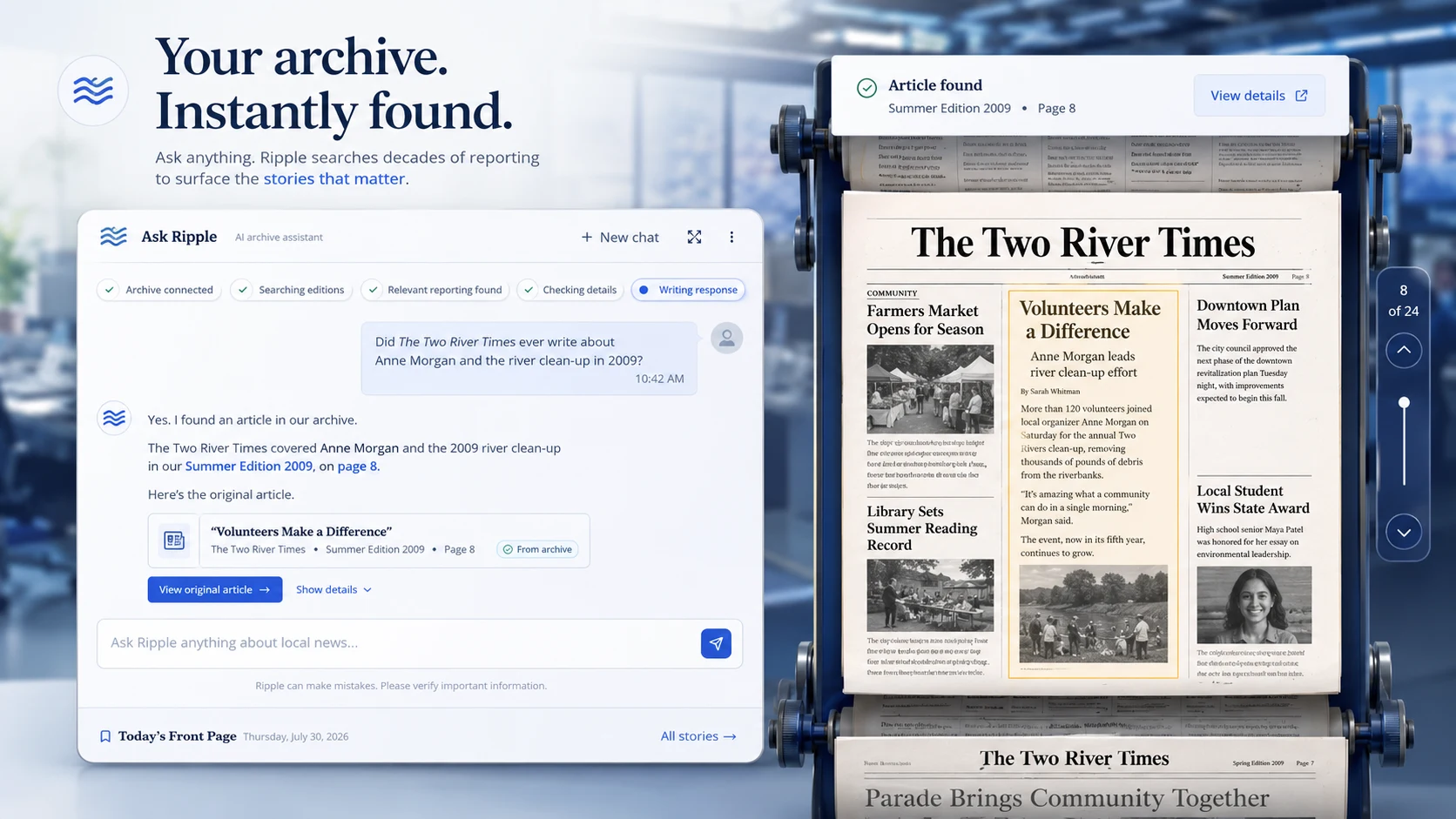
The archive answers, and shows the page it came from.
A reader asks a question in the words they would actually use, naming a person and a year rather than a date. Ripple retrieves the article, states the edition and page, and puts the original printed page alongside the answer.
Every answer carries its source. The citation card, the “From archive” tag and the page reference are the interface, not a footnote. The original page is one click away, so the claim is always checkable.
The retrieval steps are visible. Archive connected, searching editions, relevant reporting found, checking details. The reader can see it is looking things up rather than composing.
The paper still looks like the paper. The right-hand pane is the printed page as it ran, with the cited article picked out and a page-through control. This is the reader experience the team has asked for repeatedly.
WorkstreamsW2 retrieval and citation · W3 metadata · W4 member layer · W6 paper-style reader.
Read this against section 02. Comfort with AI at the paper runs at 60% against 11.6% uncomfortable, and the gap is produced by telling readers what the tool does. That is what this layout shows: a named person, a dated edition, a page number and the original article. The query itself is the survey's own use case: “it’s easy to lose track of these once the article is out.”
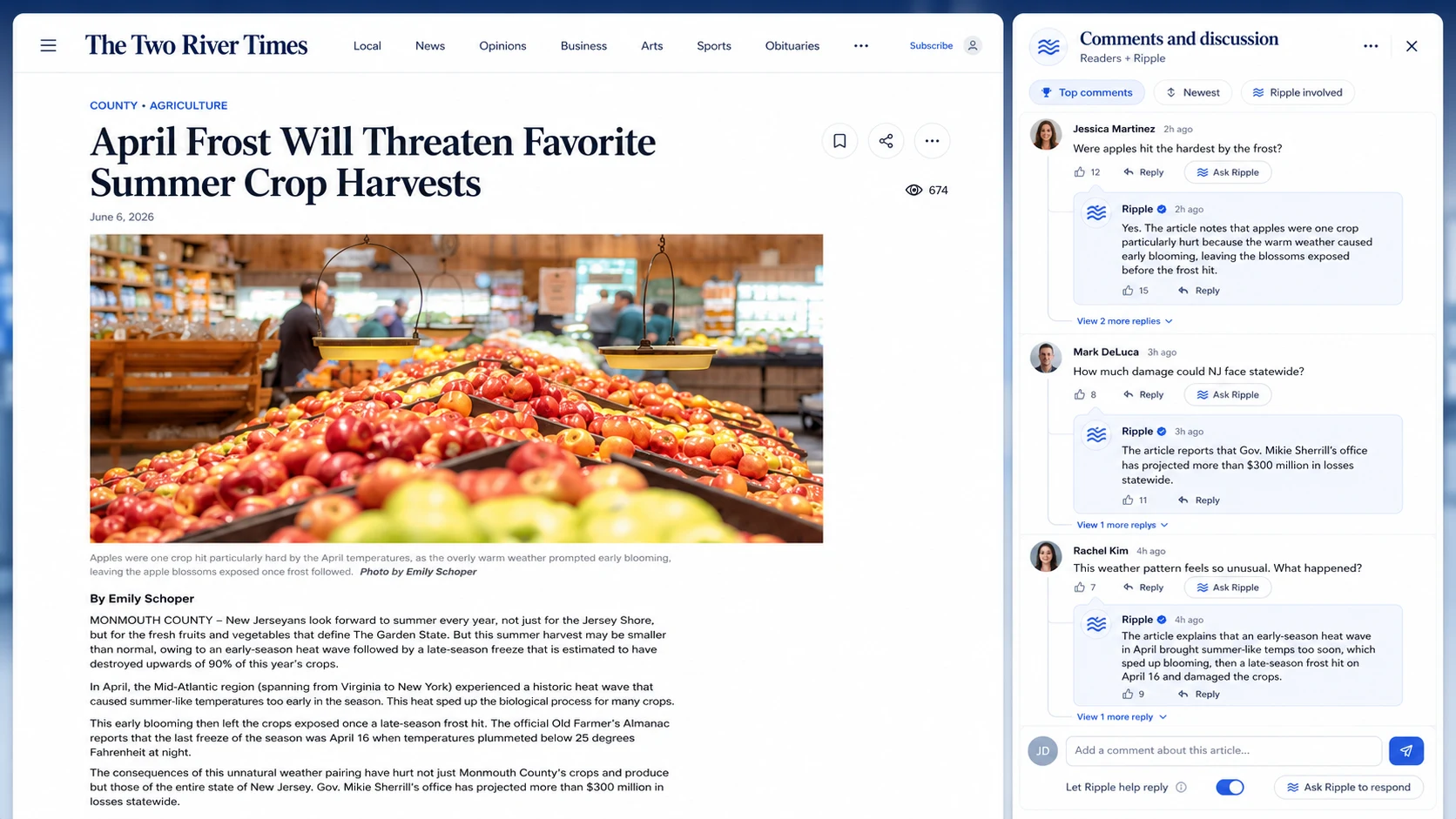
Readers ask. Ripple answers from the article, in public.
A discussion panel alongside the story, where readers put questions to each other and to Ripple. Each reply is drawn from the piece they are reading. The comment thread becomes a place the newsroom can see what the story left unanswered.
Every reply is scoped to the article. “The article notes…”, “The article reports…”, “The article explains…”: the same surface-never-rewrite rule as the archive, applied to a public space. Ripple is answering from the piece in front of it, not from the open internet and not with a view of its own.
Ripple speaks when asked, not by default. “Ask Ripple” sits on each comment, the verified badge marks its replies as machine rather than neighbour, and the Ripple involved filter makes its participation auditable in one click.
The composer is the newsroom half. “Let Ripple help reply” drafts a response for a member of staff with the archive behind it: a reader question answered in minutes rather than the several a week the front desk currently fields by hand.
Commenting is a membership lever, not just a feature. Two options worth testing: reserve posting for members outright, or let anyone comment once they give an email, which turns every person with an opinion about a story into a named prospect. The second is softer and almost certainly the better opener.
WorkstreamsW2 retrieval and citation · W8 insight and engagement data.
The survey asks for reader voice and does not yet license this. Two readers asked for it unprompted: “Offer space in the newspaper for letters to the editor. Let your readers speak” and “relevant commentary”. One named the precondition exactly: “Local news. Volunteer opportunities and NO trolls.” A moderated space on the paper's own site is also the answer to the reader who wrote that they “choose not to participate in social media” but cannot otherwise follow their township.
The comfort finding does not stretch this far. Question 18 measured comfort against transcription, research assistance and archiving. It never described AI replying to readers in public under the paper's own badge. That use is more exposed than the three the question tested. Community discussion is also the lowest-scoring civic action in the survey at 10.7%, well behind sharing at 72.9%. Put this specific use to readers before building it. The 168 who left an email are the panel, and it is one question.
The first member benefit that isn’t something to read.
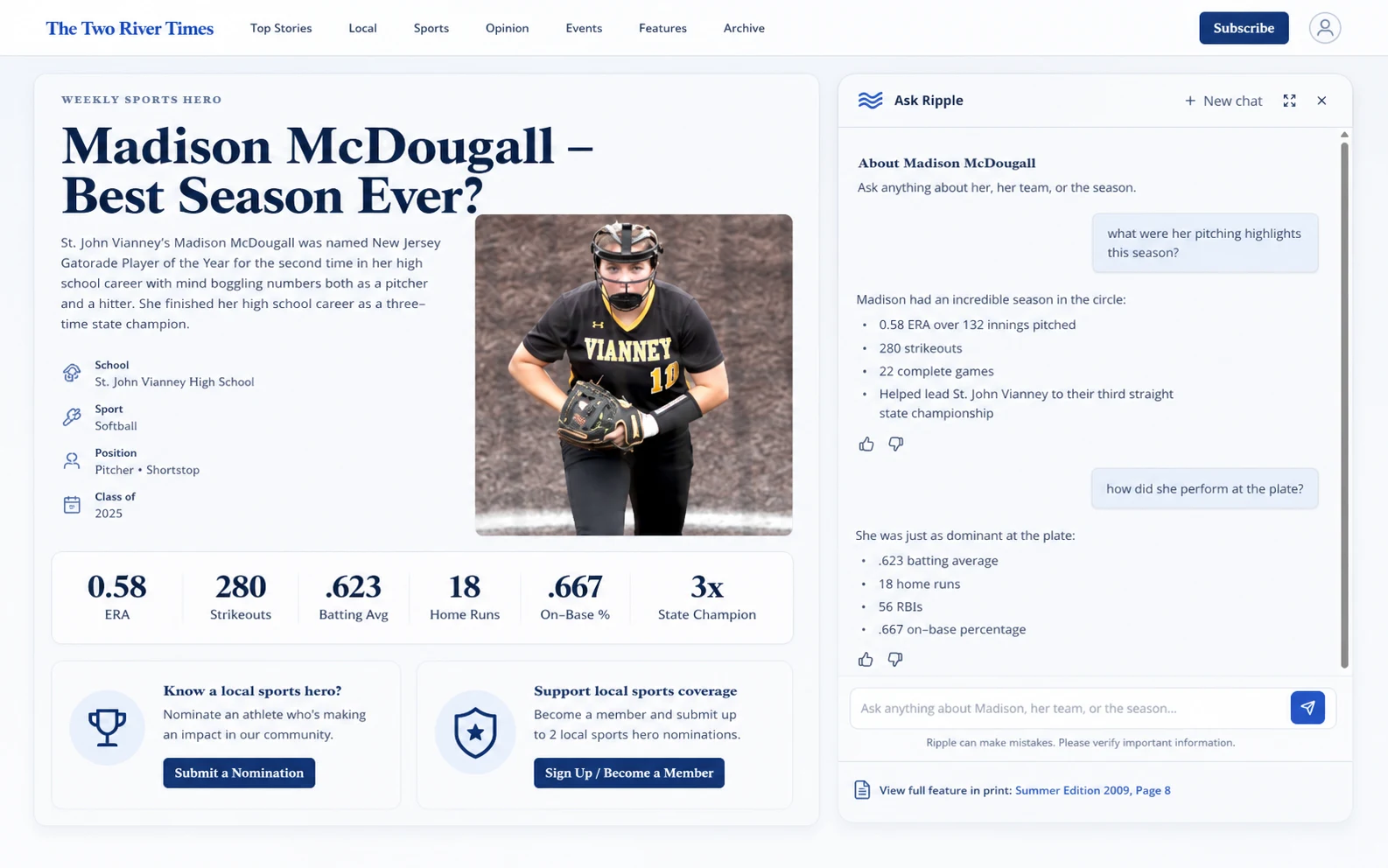
A weekly sports hero feature, where the right to nominate an athlete is reserved for members and capped at two a year. The paper already runs person-centred coverage; this turns it into a reason to join. Sport is the obvious first subject rather than the only one. The same mechanic works for a young musician, a volunteer, a business that has survived fifty years.
The nomination is the benefit. Scarce, gated on login and capped. It is something a member does rather than another thing to consume. It is the second concrete answer to “what do I get for the hundred dollars?”, and unlike archive access it is one a member can hand to somebody else.
The nomination is the moment of intent. W7 exists to stop a payment form losing a reader at the point they decide to act. A nomination is a stronger signal of intent than browsing, and it arrives with a name and a school already attached.
Ripple is scoped to one subject. The panel answers about this athlete, her team and her season and nothing else, with a rating on every answer. This is the narrowest and most checkable version of the pattern in Figure 01, and the one that generates the least room for error.
WorkstreamsW5 login and membership status · W7 sign-up at the moment of intent · W8 contacts.
Do not judge this one against section 02. Sports is the lowest coverage priority in the survey, at 1.86% (eight people in 431). But the survey reached the existing readership: 82% have followed for over a year, 65% are 65 or older, under-45s are 4.7%, and only two respondents in 517 had never heard of the paper. The audience for a sports-hero nomination is the athlete's parents and grandparents, which is precisely the group this survey could not see. That makes it an acquisition play, and this dataset can neither support it nor refute it. What the data does show is an audience that acts on what it reads (72.9% share articles) and a standing appetite for the paper's people coverage: “read about the people in our community who make a difference in the lives of others.”
Two things to settle before this is built. It gates on membership status and a per-member quota, which puts it squarely behind W5 (the workstream already named as the most likely cause of slippage), because no API has been confirmed with News Revenue Hub. And it publishes the names and photographs of children, submitted by third parties: consent, verification and moderation need a written policy before the first nomination form goes live, not after the first complaint.
A digest built per reader rather than one email to everyone.
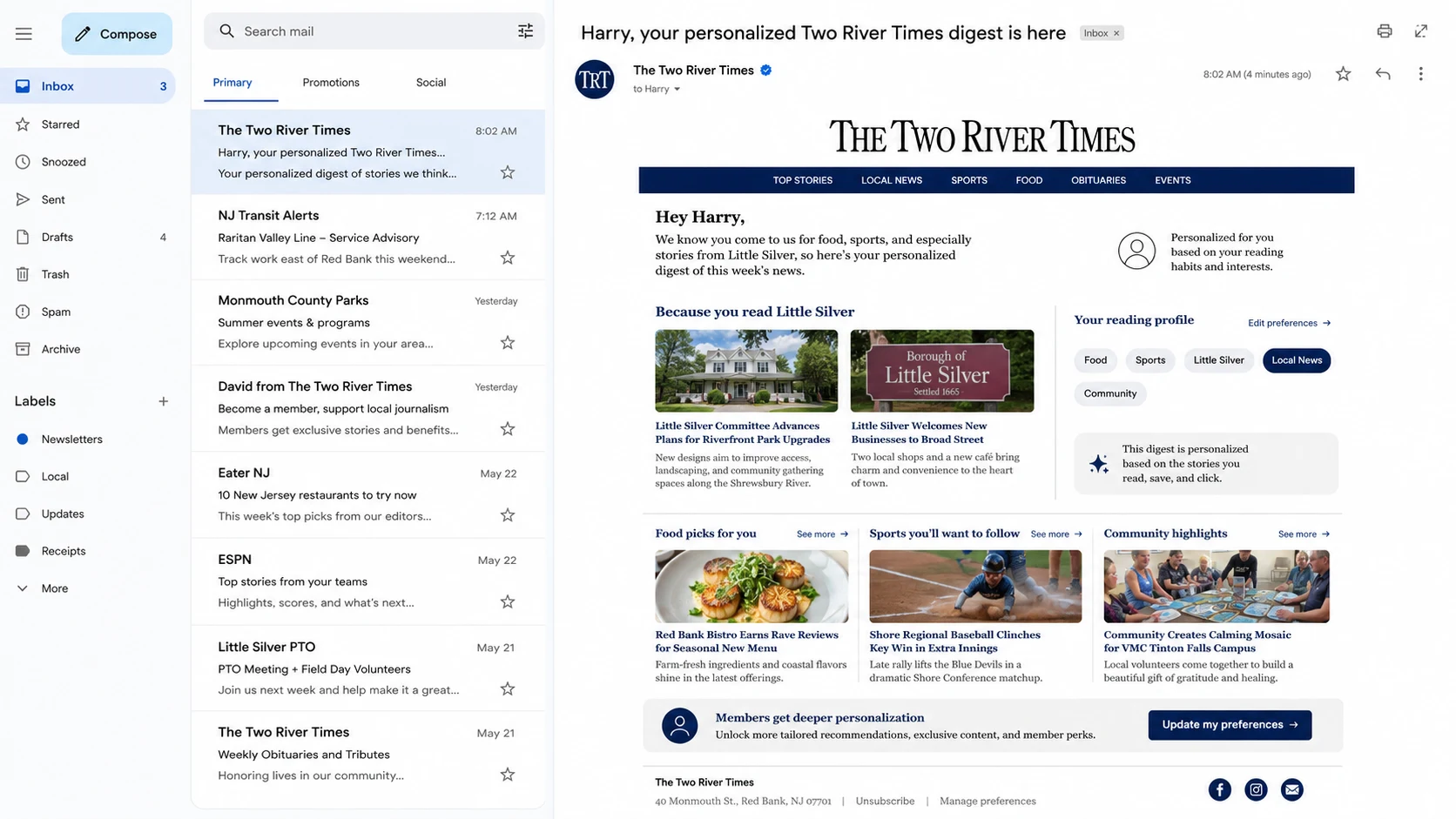
A weekly digest assembled per reader from what they actually read, led by their own town. The member record and intake flow are what make it possible; the email is what the reader sees of it.
Place is the first axis, not an afterthought. “Because you read Little Silver”: Little Silver is the second-largest town in the survey at 8.9%. Towns are the second coverage priority at 18.6%, and the free text carries repeated requests for individual towns: “more coverage of my town”, “I wish there was more about Freehold”, “summaries of Oceanport Council meetings”. The digest applies W3’s metadata model to the mailing list.
The reading profile is visible and editable. Interest tags the reader can change, and a plain sentence saying the digest is built from what they read, save and click. Personalisation that hides its inputs reads as surveillance. Stating the inputs is the same disclosure that produced the comfort figures in section 02.
The upsell sits inside something already useful. “Members get deeper personalisation” runs at the foot of a digest a non-member has just read to the end. That is the public layer earning the membership rather than withholding until it is bought.
WorkstreamsW8 contacts and outbound · W6 digital newsletter · W5 membership status. The preference intake flow is what turns the rest on.
This closes two gaps section 01 already names. Member interest data is listed there as absent (“no per-member profile of what a reader actually cares about, so nothing can be tailored”) and described as the precondition for everything in W5 and W6. Lifecycle email is listed as live but “sending the same content to everyone”. Figure 04 is both of those closed.
The unplanned benefit: it fixes a delivery complaint. The most repeated operational grievance in the survey free text is not about content at all. It is that the paper arrives too late to act on. “Information arrives too late. Events have expired.”“My last subscription arrived on Monday. Getting my paper in a timely manner is important.”“Happy to pay for paper. Must come in reasonable time.” A weekly email that lands on a fixed day answers that without touching the print operation. One reader has already told us the channel they want: “ask me via email or letters.”
It needs data the paper does not hold yet. Per-reader behaviour tied to an identity, and a reliable answer to whether that identity is a member. That is W5, and the News Revenue Hub API that is still unconfirmed. Until the intake flow exists there is nothing to personalise against, so this should be sequenced early rather than treated as a finishing touch. It also means tracking what a named person reads: the Edit preferences and Manage preferences controls in the design are the right answer, and they need a written policy behind them.
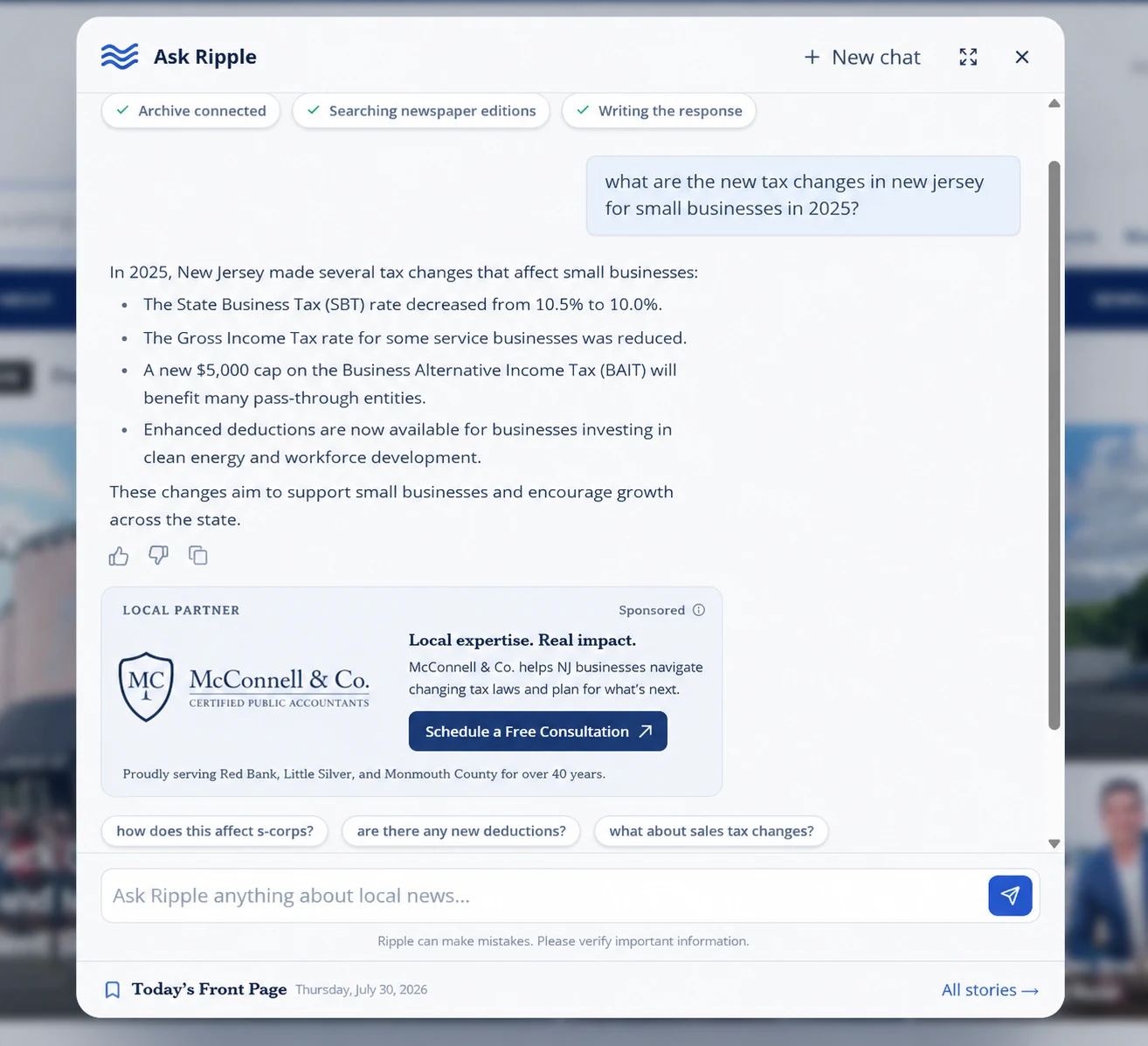
A local partner, where the question makes them relevant.
Sponsorship attached to subject matter rather than to page furniture. A reader asking about small-business tax meets a local accountancy practice, labelled as sponsored, in the place a directory entry would once have sat.
Sponsorship can be sold on a recorded action rather than on impressions.49.4% (213 readers) visited a community business because of something they read in the paper.
Readers proposed this themselves. Asked what would make them support the paper, four wrote in unprompted that it should sell advertising instead of asking them for money: “take on more advertising”, “you should depend on advertising”, “you need to raise money through advertising”. One reader lists “interesting local advertising” among the things they come for.
Labelled, local, adjacent. LOCAL PARTNER, a sponsored marker, a named firm and a stated Monmouth County history. The format reads as a directory entry beside an answer rather than as an interruption inside one.
The subject was chosen by readers, not by us. Four of the 28 answers to the survey's open question about what readers wish was easier to understand named tax: property tax, senior exemptions, why the bills are what they are. The question did offer tax as an example, so treat it as prompted rather than spontaneous; but a category readers raise unprompted-ish is also a category a local firm will pay to sit beside.
Sell it on measured demand, not on a projection. Launch without sponsors, publish nothing, and count: how many finance questions a week, from how many people, in which towns. A rate card backed by the actual weekly volume of local people asking about tax is easier to sell than one built on estimates, and one quarter of data produces it. Ten partners covering the recurring categories is a more realistic first target than an open marketplace.
WorkstreamsW2 retrieval and citation · W4 public layer · W8 insight. Knowing which questions carry commercial value is the analytics W8 already produces.
The answer in this mock carries no source. Figure 01 cites an edition and a page and puts the original alongside. This one states four specific tax facts with no citation, and the content is general policy rather than Two River Times reporting, which crosses the line W2 exists to hold: surface, never rewrite. An unsourced answer about tax sitting directly above a paid accountant’s call to action carries the highest risk of the five concepts. The fix is a rule rather than a feature: sponsorship attaches only to answers that cite the paper’s own journalism, and where the archive has not covered something Ripple says so instead of composing.
Somebody has to own which questions a sponsor appears against. A firm that buys “tax” could appear beside a tax fraud prosecution or a council budget dispute. That is an editorial policy decision, and it has to be made before there is a rate card, because it determines what can be sold. The nearest precedent in this report is historic pages carrying live advertiser links, which is a simpler case: a 1998 page has no live news judgement attached to it.
Figures 01 to 05 are design concepts produced for this report. Headlines, bylines, commenter names, athlete details and page furniture in them are illustrative and are not real Two River Times articles, readers or subjects.
04
What Ripple becomes. Beyond the twelve weeks.
None of this is in the September scope. It is here so the board can see what the archive layer makes possible once it exists, and decide what is worth funding next. The concepts below came out of the workshop sessions rather than from us.
A living museum, not a search box
The archive is the paper's most distinctive asset. A guided route through decades of local history (by decade, by street, by family name) rather than a query box. Plausibly a screen in the reception of the building, not only a page on the website.
Talk to the archive
Voice in, voice out. For an older readership this removes the barrier of typing a query, and makes the archive usable by readers who would not use a search box at all.
The archive as a revenue surface
Historic pages carry historic advertising. Presenting archived issues as browsable pages with live advertiser links gives sponsors a reason to value the archive too: visibility and click-through against decades of page views, and a new thing for the sales conversation.
A content engine for the newsroom
Thirty-five years of back issues is a supply of recurring copy. “This week, thirty years ago.” Every ghost story the paper ever ran, gathered for Halloween. The archive becomes a source of new pages as well as a reference.
Buy the edition, not the membership
A reader looking for the week a relative's obituary ran, or the issue covering a particular storm, wants that edition rather than a subscription. A single edition as a paid download costs a few dollars and needs no account. It takes payment from a visitor who would not convert on a membership prompt. Members get an allowance of downloads included, which makes it a membership argument as well as a transaction. The paper has considered à-la-carte sales before; the archive is what makes it possible.
Ripple as a local marketplace
The contextual placement that puts an accountant beside a tax question works the same way for local produce, independent shops and makers. It gives the paper an advertiser conversation with businesses too small to buy a display ad. The survey supports the model: 49.4% of readers visited a community business because of something they read.
Recognising the people who fund it
Giving Circle members and grant funders are currently thanked ad hoc, and there is no standing way to do it. A recognition layer that Ripple itself knows about turns recognition from an occasional gesture into part of the product. It acknowledges a supporter when their name comes up, and gives a supporting business a link back to it. The top tier is measured in tens of members, not hundreds. That is small enough to handle each one individually and large enough to matter to the budget. It also attaches something visible to the tier above $100, a gap identified earlier in this report.
Pre-2007, and who does the digitising
Everything before 2007 (CDs, zip discs, and paper back to 1990) needs scanning before it can join the index. The cost is labour, not technology, and the obvious answer is a partnership with a local college: student placements digitising their own community's history, with the paper reporting on it as it happens. That turns an expense into a story and a relationship. It should be scoped as its own phase with its own budget, not absorbed into the twelve weeks. Start with a single CD as a test before committing to the volume.
Deliberately parked: the community events hub. Local nonprofits would post events to avoid clashing dates, with the paper as the hub. It is a strong idea with a plausible revenue line, and it is a separate product. Naming it here so it is not quietly folded into Ripple's scope.
Precedent: where this has worked.
Digital editions with live advertising
The page-through digital edition model, familiar from platforms the team has already evaluated, showed two things: readers want to see the paper as a paper, and advertisers will pay for links inside an archived page. Fidelity to the printed object matters. The older platforms were slow, which is where a modern build should improve on them.
Newsrooms querying their own archives
Larger publications have trained assistants on their own back catalogue so reporters can ask whether a subject has been covered before. It is established practice at scale, but it has stayed internal and stayed with the big titles. Pointing it at readers, at the size of a local paper, is the part that is genuinely new here.
Precedent noted in the joint session with News Revenue Hub, 20 July 2026, and in the strategy workshop of 10 February 2026.
05
Twelve weeks, then year-end.
Delivery follows the Double Diamond structure set out in the signed Statement of Work (Discover, Define, Develop, Deliver) across a twelve-week build from kickoff on 1 July, with testing and refinement continuing through 31 December 2026. We are at week 6, the halfway point, with Define closed. The hatched band depends on the News Revenue Hub platform conversation and may move.
Phase · workstream
W1
W2
W3
W4
W5
W6
W7
W8
W9
W10
W11
W12
YR-END
Discover: scope, surveys, trust language
Define: architecture, metadata, storyboard
Develop: ingest, tag, build, test
Deliver: release, monitor, optimise
W1–W3 Archive, RAG, metadata
W4 Public, member, internal layers
W5 SSO & Salesforce integration
W6 Member application
W7 Apple Pay & Google Pay at launch
W8 Insight, contacts, outbound
“Building Ripple” series in the paper
Testing & refinement to 31 Dec
Legacy digitisation 1990–2007
Double Diamond phase Signed Phase 1 workstream Supporting or continuing activity Future phase, not in this SOW Decision point
Phases and week numbering follow the signed Statement of Work, May 2026. The red line marks week 6, the halfway point, where the engagement is now: Define closed at the end of week 5 with the archive scope, metadata model, Salesforce requirements and app format all confirmed, and a draft AI search bar is ready to share. Week 12 is the public release of Ripple V1, with one-click payment live. Year-end is when testing and refinement complete; the annual licence period begins 1 January 2027.
06
Risks and considerations.
Seven failure modes with the mitigation and the residual risk stated. Two are outside our control and are named as such rather than dressed up.
Failure mode
Mitigation
Residual risk
Readers react against AI in their local paper
Report the build in the paper from the start, in the paper's voice, including the objections. Publish the editorial line: Ripple surfaces journalism, it never writes it.
Medium. Some readers will object regardless. Reporting the build as it happens frames it as archive stewardship. Not reporting it leaves room for the story that the paper is replacing journalists.
The audience cannot or will not use it
Design for the readership that exists rather than a younger one. Voice input, plain prompts, and no assumption of familiarity. Public workshops at a genuine beginner level.
Medium. The demographic skew is real and is the largest product constraint.
Personalisation does not beat a broad appeal
Run both against the same campaign and measure. Adopt whichever wins on this audience.
Known unknown, deliberately. Experienced practitioners in nonprofit news consider broad mission appeals highly effective and this approach unproven. That disagreement is the reason to test rather than assume.
The membership platform cannot carry the changes
Open the technical conversation in week 6 rather than week 11. Fall back to gathering interests through the annual survey or a follow-up email.
High, and outside our control. The product has just been sold to Indiegraph, editing is limited and no API is confirmed. This is the most likely cause of W5 and W6 slipping.
Pre-2007 media turn out to be unreadable
Test one CD and one zip disc before scoping the phase. Physical copies are the guaranteed fallback and can always be scanned.
Low for the twelve weeks, since none of it is in scope. Material for the phase-two estimate.
Ripple answers confidently and wrongly
Every response cites the issue it came from. Ripple retrieves published material and points at it rather than composing prose about it.
Medium. A local paper's credibility is its whole asset. Citation is not a nicety here; it is the safeguard.
The membership gate suppresses usage
Start generous, measure, tighten only on evidence.
Low. Easy to reverse, and visible in the numbers within weeks.
07
The midway review. Where this stands at week six.
A plain reading of the first six weeks, drawn from the shared session transcripts, the survey and the work itself rather than from ambition. Positive where the evidence is positive, and no further.
A good first half, stated plainly
The foundations are real rather than promised. The archive from 2007 onward is chunked, indexed and answering questions with citations. A draft AI search bar is ready to put in front of readers. The audience survey came back with 517 responses and has been analysed in full, and the working sessions in February, June and July have given the build a shared language across the newsroom, the Foundation and News Revenue Hub. Define closed on schedule at the end of week 5.
The same honesty cuts the other way. The reader-facing half of the build is still ahead, the membership platform's API position is still unconfirmed, and nothing in the survey has yet tested the product itself. The first half earns confidence, not a verdict. Section 06 stands unchanged.
Ripple can stand as a brand of its own
Six weeks of discovery keep pointing at the same conclusion: Ripple is becoming more than a feature of the website. It has a name readers can address, a rule they can check (surface, never rewrite) and a growing family of surfaces: the archive, the comment thread, the digest, the nomination. That is the outline of a standalone brand, and it is worth treating as one. Ripple can be the home for the paper's new innovation and experimental work, where a new format or revenue surface launches under Ripple's name, earns its keep, and only then asks for the masthead's authority. The concepts in section 04 came out of the workshops for exactly this reason: the appetite is already there.
Beyond the county line
Locally, the case the evidence makes is for depth rather than breadth: fewer concepts, built properly, each one closing a gap this report names in the paper's own connection to its community. Nationally, the questions this project is answering are the questions every nonprofit newsroom in the US is asking: what an archive is worth, how AI earns a reader's trust, and how membership pays for both. Answered in public, with the survey data and the decisions attached, this work makes the Two River Times a reference case and gives Ripple a claim to thought leadership across the sector. The halfway position is that both are still available: a deeper local product, and a model other newsrooms can follow.
08
Revision one, 26 August. The launch order, and the membership platform decision.
The first dated revision, added in place: sections 00–07 are the 6 August text, unchanged. Since then the launch order has been set, and the News Revenue Hub technical review has taken place (25 August, transcribed). Below: the facts, the three routes, and the appraisal that separates them; the diligence closes by 8 September. Where a position is stated rather than a fact, it is Whitelabel’s, and marked as such.
The launch order: free first, charge at the archive door
Launch · freeThe AI layer, open to everyone
Ripple, archive search and the comment surfaces, no login. Usage becomes the evidence the survey could not give (W8).
→
First revenuePay at the archive door
Asking stays free; downloading an original does not. The first checkout this project ships (W7), live from launch.
→
Membership$100, unchanged
No new premium tier at launch. Tiers and the W4 question allowance are set against usage data, not guesswork.
The Hub put the right challenge to us on the call: is there enough content for personalisation to feel personal? Free-first is the answer: ship, measure which features hook, and double down where the evidence lands. The standing constraint holds — none of this gives away what the printed paper sells.
What the technical review established · 25 August, transcribed
The platform is RevEngine
Deliberately simple: “what you see is really what you get”. Development passes to a Canadian exclusive reseller; a site-embedded checkout is on their roadmap, no date. Today the joining flow leaves the site for a hosted page.
Custom forms: no
A custom form cannot write to RevEngine — confirmed plainly. Page tweaks within product limits, on request. RevEngine’s real jobs: recurring payments on Stripe, and the receipts portal.
No API — and it does not matter
Salesforce carries a near-complete facsimile of the platform’s data, and the richer payment metadata sits in Stripe, which Whitelabel already connects to.
The seam is Salesforce
Paper-owned licences, the Hub’s NPSP packages, home of circulation and the printer’s list. Whitelabel syncs both ways and keys member logins to the record (W5): identity becomes scheduled work.
A conflict to name. Whitelabel builds membership infrastructure, which makes us effectively a competitor to News Revenue Hub on this question. So the review is reported in its own words above, the appraisal below scores costs as well as cases, and the decision is the Foundation’s, on numbers presented openly. The Hub’s record is real: nearly 4,000 members and the print circulation run on their rails today.
Route one is the launch posture made permanent; routes two and three are what switching the member tier on looks like. The difference between those two is where the checkout lives, and what joining feels like the moment after paying.
Route one · all public
No member-only features: every Ripple surface stays public, and membership runs exactly as it does today. The AI earns renewals by being valuable, not by gating.
Route two · keep RevEngine, activate with Whitelabel
RevEngine keeps the checkout. Each new member lands in Salesforce, which triggers a Whitelabel sign-in email: set a login, unlock the member features and personalisation, and complete a short tell-us-more flow capturing the interest data the hosted form cannot.
Route three · full Whitelabel
RevEngine retires at the front door: every new member joins on Whitelabel pay, while existing payments keep running through Stripe exactly as they are and wind down naturally at renewal. Mailchimp retires; Salesforce keeps circulation and the books.
Checkout built for conversion · wallets, one page (W7)
✕
~b
✓
Personalised member email · Mailchimp retires
✕
✓
✓
One-step join · no activation drop-off
✓
✕c
✓
No forced migration of recurring payments
✓
✓
✓d
Renewals and receipts continuity
✓
✓
✓e
Fully in the paper’s control · nothing needs the Hub’s agreement
✓
✓f
~f
Retires duplicate running costs
✕
~
✓
Live soonest
✓
~
~
No new build cost · inside the signed agreement
✓
✓
✓
✓ delivered · ~ partial or conditional · ✕ not on this route. a captured at activation rather than at checkout: only members who take the sign-in email complete the tell-us-more flow. b the hosted page as it is; hangs on the Hub’s wallet answer and the permitted tweaks. c pay on the Hub’s page, then activate by email — a second step some members will never take, so the activation email becomes a conversion point to design hard. d nobody is asked to move: existing payments keep running through Stripe exactly as they are and wind down naturally at renewal, while every new join starts on Whitelabel pay — the account arrangements behind the run-down are diligence two. e existing members keep today’s renewal and receipts rail unchanged through the run-down; Whitelabel provides both for every new join from day one. The cost is a spell of two rails running side by side. f route two’s sync out of Salesforce was the Hub’s own suggestion on the call; route three needs their cooperation on a managed wind-down of the old rail, not their permission.
Our readRoute three, if the numbers hold — the platform was commissioned to carry exactly this.
Diligence one · the numbers
A cost analysis presented back to Two River Times: what the current stack costs a year against the same services on the already-commissioned platform.
Priced: RevEngine platform fees · the Hub’s Salesforce administration · Salesforce licences · Mailchimp · Stripe’s processing take. The build itself adds nothing: licence and development sit inside the signed, grant-funded agreement. New joins on Whitelabel pay carry the same card costs, with the option for supporters to cover the processing fee at checkout — so the paper’s take does not fall.
Diligence two · the access
Whitelabel needs admin access to Salesforce, Stripe and RevEngine to run the final technical review and confirm the read in this section is correct — including whose Stripe account holds the existing subscriptions, which sets the run-down terms on route three.
The standing questions to the Hub — wallets on the hosted page, the embed timeline — still go; route two lives by them.
Decision by 8 September. Both pieces of diligence land first, and launch does not wait: the free-first order above is route one in action while they run. The Foundation decides on the analysis, and the next revision records it.
What this revision changes, workstream by workstream
W4 · The public tier launches open and unmetered; the question allowance switches on against usage.
W5 · Unblocked — identity and entitlements proceed now over the Salesforce sync.
W6 · The member application proceeds behind W5’s login; scope unchanged.
W7 · The first checkout shipped is the archive download door; the joining journey rides on the route decision.
W8 · Analytics move ahead of pricing: usage is the input to tier design, not the audit of it.
Added 26 August 2026 as revision v1.1. Sections 00–07 were not edited. Source: technical review with News Revenue Hub, 25 August 2026, transcribed. Position statements are Whitelabel’s.